

Jul 6th,2026
High-quality rubber tiles deliver excellent safety, durability, and aesthetic effects for public, commercial, and sports spaces. However, professional standard installation is the key to maximizing the service life and stable performance of rubber flooring. Even premium-grade rubber tiles may suffer from warping, bulging, loosening, or premature aging due to irregular construction. This article systematically introduces the complete installation steps and essential precautions for rubber tile paving, providing reliable technical guidance for contractors, project builders, and venue managers.
Standard rubber tile installation is divided into four core stages: base preparation, pre-installation preparation, formal paving, and post-installation finishing. Each step follows strict construction specifications to ensure flat, firm, and neat flooring results.
A qualified base surface is the foundation of stable rubber tile paving. First, thoroughly inspect the ground condition of the construction area. The base can be cement, asphalt, or concrete ground, which must be flat, solid, dry, and free of cracks, pits, and floating dust. Repair uneven ground, fill potholes, and polish raised parts to ensure the overall flatness error is controlled within 2mm. Clean all dust, oil stains, gravel, and sundries on the ground to avoid affecting the bonding and laying tightness of rubber tiles. For newly poured cement ground, ensure complete curing and full drying before construction to prevent internal moisture from causing tile bulging and mildew.
Before formal paving, complete on-site layout planning according to the venue size, functional zoning, and design scheme. Confirm the color matching, splicing method, and laying direction of multi-color and special-shaped rubber tiles in advance to avoid layout chaos. Unpack the rubber tiles and place them flat in the construction environment for 24 hours to adapt to the on-site temperature and humidity, effectively reducing the probability of thermal expansion and contraction deformation after installation. Meanwhile, check all tiles for quality defects such as color difference, damage, and deformation to ensure consistent paving effect.
Start paving from the fixed reference corner of the venue to ensure neat and orderly overall layout. For interlocking rubber tiles, align the lock edges of adjacent tiles tightly and press them firmly to avoid gaps and loosening. For glued rubber flooring, evenly apply special environmental-friendly rubber floor adhesive on the base surface according to the standard dosage, and paste the tiles flat while ensuring no offset or warping during bonding. During the paving process, real-time check the flatness and seam tightness of each tile, adjust the position in time, and keep the overall lines smooth and uniform. For functional areas such as boundaries and dividing lines, strictly follow the design standards for accurate splicing.
After the overall paving is completed, perform edge trimming and finishing treatment on the surrounding edges of the venue, cut off redundant tiles neatly, and install edge strips to make the venue boundary neat and beautiful. Remove excess adhesive and surface stains in time, and clean the whole floor thoroughly. After construction is finished, close the venue and prohibit pedestrian stepping and heavy object pressing within 24–48 hours to ensure the adhesive is fully cured and the tiles are firmly fixed.
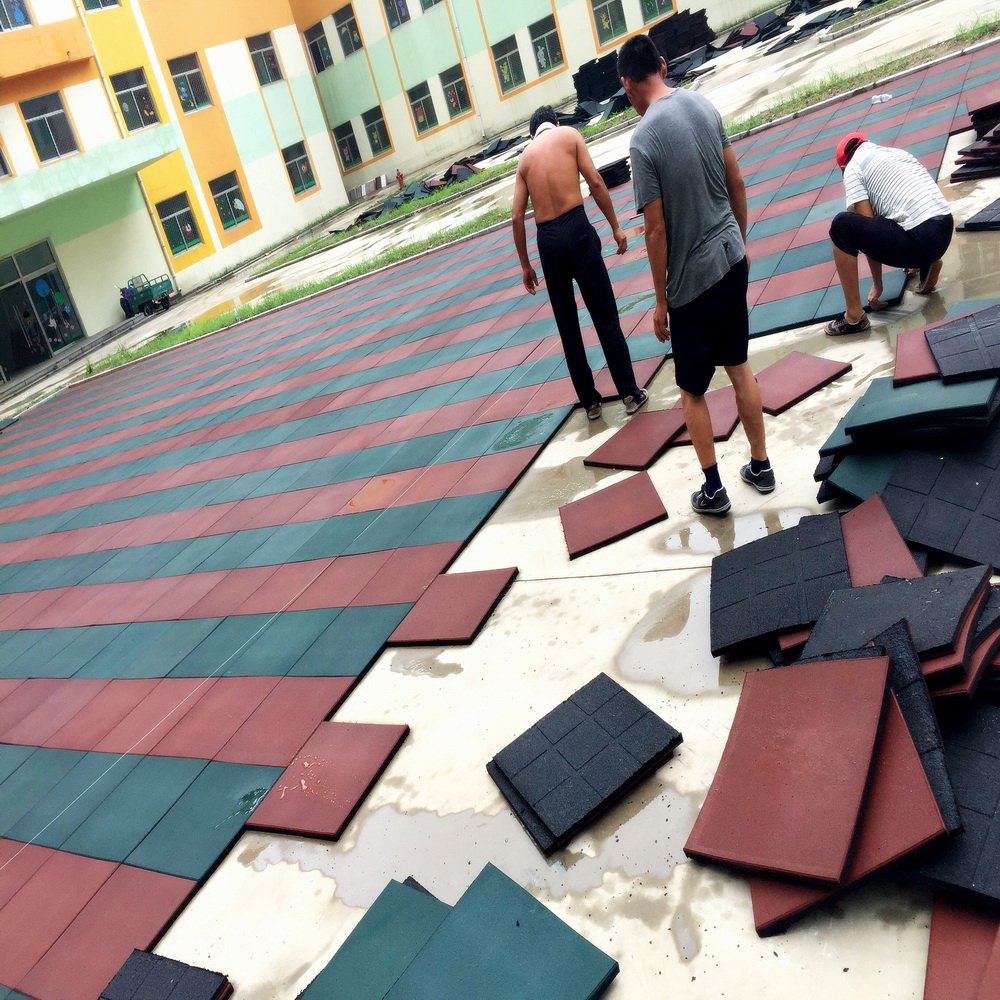
To avoid common construction problems and ensure long-term stable use of rubber tiles, the following key precautions must be strictly followed during the whole installation process:
Rubber tile installation is greatly affected by temperature and humidity. The optimal construction temperature is 10℃–35℃. Construction is prohibited in extreme low temperature, high temperature, rainy days, and humid environments. Outdoor construction should avoid rainy and snowy weather to prevent water accumulation on the base surface before paving. Indoor construction needs to keep the environment ventilated and dry, avoiding excessive humidity leading to poor bonding effect and subsequent mildew problems.
Do not use inferior ordinary glue for rubber tile installation. Must choose special environmental-friendly, waterproof, and aging-resistant rubber floor adhesive to ensure bonding strength and avoid formaldehyde exceeding standards and glue failure. Master the uniform glue application dosage, avoid excessive glue overflow causing surface pollution, and prevent insufficient glue amount leading to hollowing and loosening of tiles.
During splicing, ensure no gaps, misalignment, or height difference between adjacent tiles. Do not pull or squeeze the tiles forcibly, so as not to cause deformation and affect the overall flatness. For multi-color and special-shaped customized tiles, construct strictly in accordance with the pre-designed layout to avoid color confusion and irregular splicing, which damage the aesthetic effect of the whole venue.
After installation, keep the construction site well ventilated to accelerate adhesive curing and eliminate slight odor quickly. Strictly follow the curing cycle, and prohibit walking, rolling equipment, and placing heavy objects on the floor before full curing. Early use will easily cause tile offset, bulging, and uneven surface, affecting the service life of rubber flooring.
After the floor is completely cured, daily protection should be done well. Avoid sharp hard objects scratching the floor surface, and prevent long-term extrusion of overweight equipment. Regular daily cleaning and maintenance can keep the rubber tiles bright and neat, effectively extend the service life, and maintain stable anti-slip, shock absorption and noise reduction performance for a long time.
The performance and service life of rubber tiles depend not only on high-quality raw materials and production technology but also on standardized and professional installation construction. Strictly following the complete installation steps and construction precautions can effectively avoid common problems such as bulging, loosening, and fading, ensuring that the rubber floor maintains flatness, aesthetics, and functional stability in long-term public and commercial scenario use.